Leadership & Management
A people-centered approach to building strong teams and sound decisions
With 12 years of experience in product design, I’ve spent the last three years leading and growing a dedicated design team. After four years as a lead IC at Axon, I was promoted into management to support our Director of Design as the organization expanded. My role was to transition a growing group of designers into a structured, high-performing team: hiring new talent, mentoring ICs through promotions, and refining our internal processes.
I lead with a pragmatic, collaborative approach. I focus on operational clarity, decision quality, and creating the conditions where designers can do strong work without burning out or losing sight of real-world consequences.
My role and scope
Title: Product Design Manager
Team: 4 designers. I focused on early-career mentorship and promoted two of my reports.
Duration: 3 years (after 4 years as a Lead designer here).
Model: Player–coach (IC + people manager)
I was responsible for the performance and growth of my team, making sure they had clear career paths and didn't hit walls. I spent a lot of my time acting as the bridge between design, product, and engineering, making sure we were all pulling in the same direction and that design had a seat at the table when planning the roadmap.
Because we worked in high-risk areas, I was the final gut-check on design decisions involving compliance or safety. I also worked closely with my Design Director to help larger team grow, from hiring new designers into our org to setting up the rituals that kept us organized and high-quality as the team grew.
How I lead people
Warmth and honesty can coexist
I try to create an environment where designers feel both supported and challenged. When feedback is grounded in respect and belief in someone’s ability to grow, it lands differently even when it’s direct.
Designers often came to me after presentations or meetings to ask how it went, sometimes sharing where they felt confident and where they didn’t. That openness helped us improve not just the work but how they showed up in conversations with PMs, engineers and leadership.
People do their best work when the work fits
I’ve found that burnout is rarely just about the volume of work, it’s often a sign of misalignment. It happens when there is a gap between the tasks a designer is doing and the type of work that actually energizes them.
I pay close attention to what gives each designer energy, where they want to stretch, and where they’re already strong. I don’t rely solely on what people say; I keep a pulse on confidence, peer feedback, and energy levels over time. My goal is to shape the work so there’s a healthy balance of challenge and momentum, ensuring the work they’re doing actually feeds their growth
Flexibility over prescription
I’m not attached to specific tools or processes unless the stakes demand it. In areas like ethical or AI-driven work, where the consequences of getting things wrong are high, I’m intentionally more structured. In other cases, I care far more about outcomes than about how someone gets there.
My goal is to provide useful frameworks and examples, then give designers room to choose the approach that fits their working style. Autonomy builds ownership, which is what leads to quality decisions.
Coaching for judgment
When I give feedback, I focus on building a designer's process for tackling complex problems. I rarely give the answer; instead, I ask the questions that help them see the edges of the problem:
Context & Intent: What is the user's situation when they encounter this? What do they expect to happen next?
Resilience: What are the ways this could go wrong? How can the system fail gracefully? How does the solution scale?
Root Cause: I often use the "Five Whys" to move past surface-level UI decisions and get to the core of the problem we are actually trying to solve.
Assumptions: What are the trade-offs we’re making, and what non-tested assumptions are we carrying forward?
The goal is to help designers build judgment rather than dependency on me. When they need direct guidance, I give it with the aim of helping them arrive at these stronger questions on their own next time.
How I lead the work
Designers as partners
I expect designers to work alongside Product and Engineering as partners. This means contributing to the product vision and helping the team bridge the gap between business KPIs and user experience. By understanding technical and business constraints early, we ensure that design isn't just aesthetic, but a direct driver of product velocity and marketplace trust.
Systems as a force multiplier
Strong design systems and libraries remove unnecessary pixel-level decisions, so designers can spend more time on understanding users, shaping flows around real mental models, and iterating on solutions. I coached my designers to lean on established patterns for speed and consistency, and to identify when a unique problem required a thoughtful deviation.
Storytelling as leverage
I spend time helping designers shape clear narratives, tailored to their audience, whether that’s leadership, engineers, peers or users. Designers are often the best people in the room at making abstract possibilities concrete. Used well, that skill helps teams align and move forward with speed and confidence.
End-to-end ownership
Designers should stay involved from initial discovery through post-launch follow-through. That includes partnering on research, contributing to problem definition, understanding business context and paying attention to data after launch. If outcomes don’t match expectations, I expect designers to notice, ask why, and help figure out the next iteration.
Systems I introduced to raise quality and clarity
I don’t believe in mandating process for its own sake. The systems I introduced were always piloted in real work first, shared with the wider team only once they proved to be useful.
A fit and finish tool: To bridge the gap between handoff and launch, I introduced a collaborative triage process with Engineering and Product. This ensured we maintained a high quality bar through the final stretch of development, to avoid details slipping through the cracks.
Design instrumentation: While instrumentation was traditionally handled by PMs and Engineers, I saw a gap in how we tracked design-led assumptions. I created a scalable framework that allowed designers to define what needed to be measured. This gave them the data to answer their own questions and directly influence further iterations of the product based on how people were actually using it.
Growth and alignment tool: I reintroduced and adjusted a framework that had previously fallen out of use. I saw a renewed need to connect day-to-day design tasks to both squad goals and individual career growth, helping designers see their impact while keeping their professional progression on track.
Thoughtful adoption of AI tools: I led through hands-on examples. The goal was to expand our design and research capabilities while ensuring we never replaced human judgment with automated output.
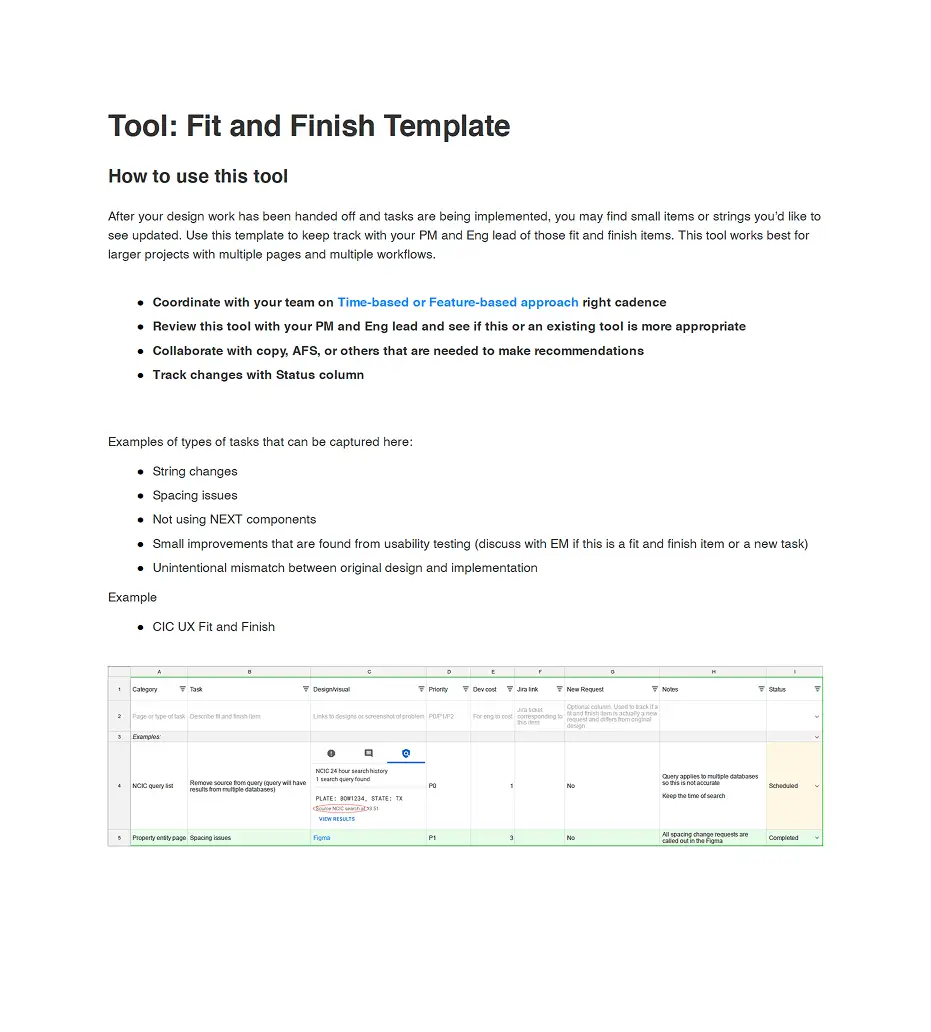
Fit and finish tool template
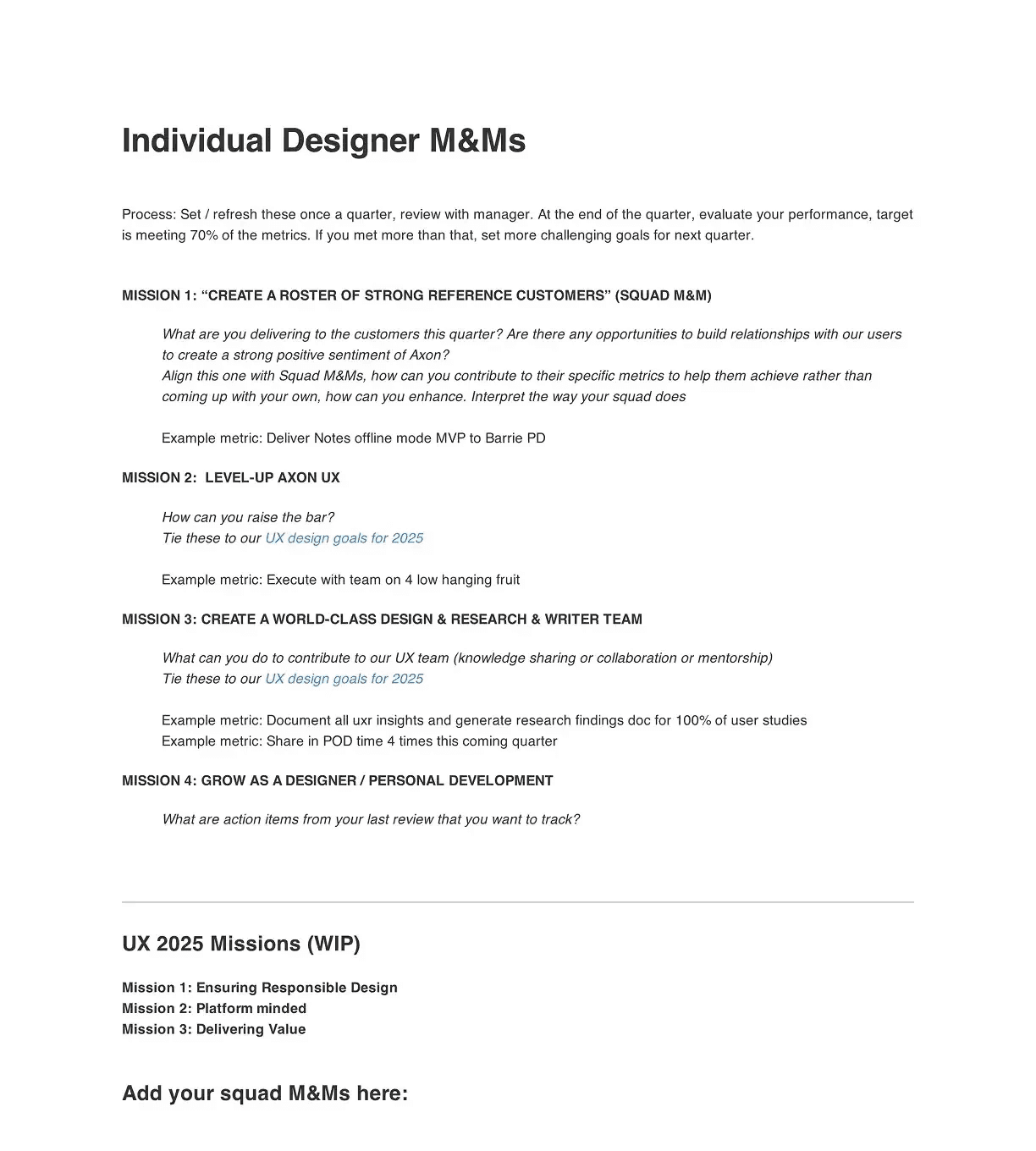
Individual mission and metrics template
What my approach creates for teams
De-risked development: Clearer alignment earlier in the software development lifecycle, resulting in fewer late-stage reversals.
Strategic design influence: Designers who are trusted as partners in decision-making and problem definition rather than just executors of the roadmap.
A self-sustaining design culture: A team that uses shared rituals and standards to maintain a high bar autonomously, reducing the need for constant oversight.
Responsible innovation: Products that balance speed and usability with a deep sense of responsibility for the end user.
I aim to improve how teams decide, build and learn, with care for both outcomes and the people behind them.