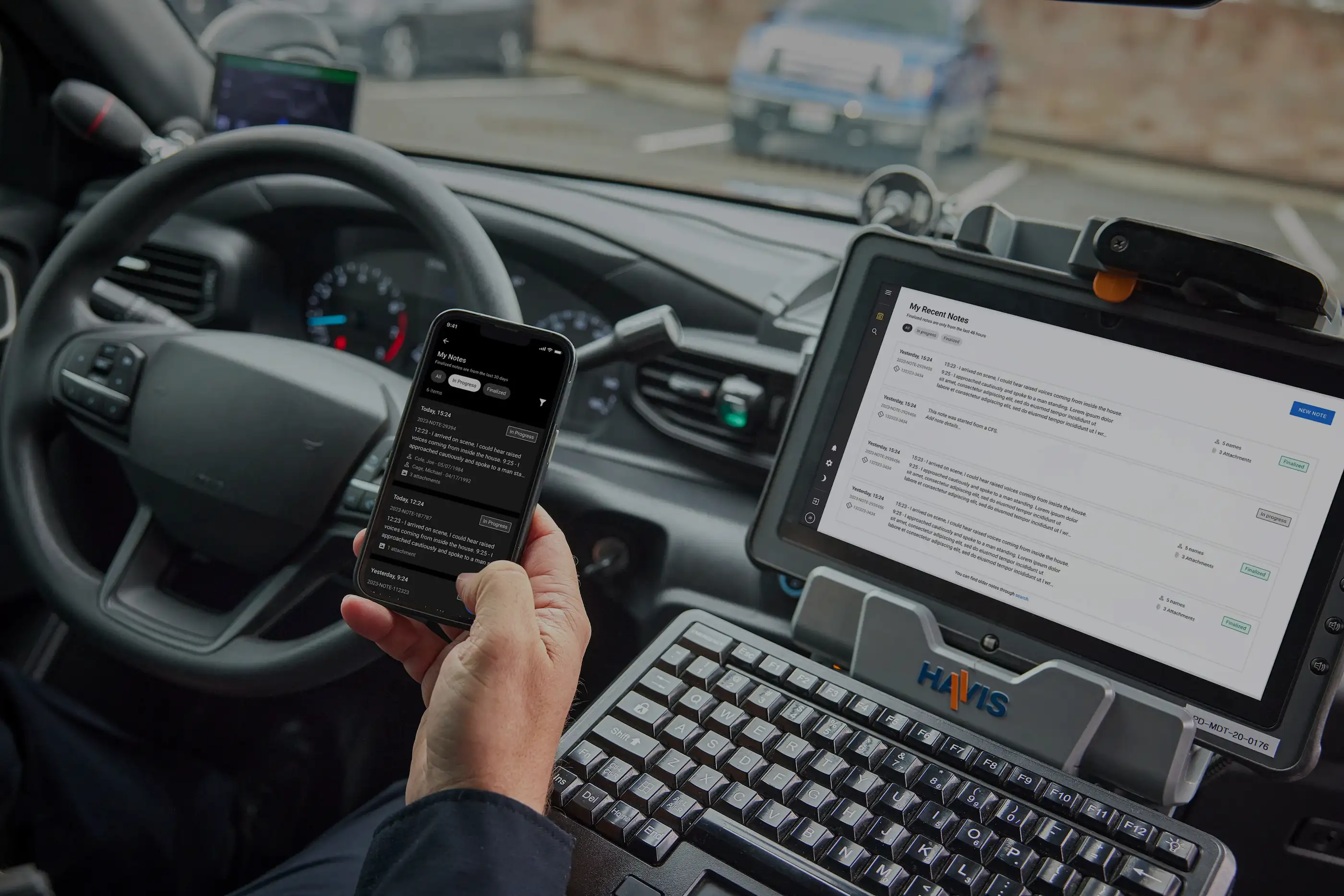
Digital Notes
Expanding Axon Records into Canada by replacing legally required paper notes with a digital system used as primary evidence for frontline officers.
Overview
Digital Notes was a zero-to-one product designed to replace paper note-taking for frontline police officers in Canada. In the Canadian legal system, police notes are the primary evidentiary record submitted to the Crown during trials. Despite the critical nature of these notes, the majority of agencies were still using paper notebooks.
At the same time, Axon was seeking to expand its Records business into the Canadian market. Agencies were hesitant to adopt a full Records Management System without first seeing how Axon software would align with Canadian legal standards and frontline workflows.
Digital Notes addressed both needs:
For officers
It modernized a critical, high frequency workflow
For Axon
It served as a strategic foot in the door, providing the proof of concept required to enable Axon’s expansion into Canada.
Project summary
My role
Lead designer & strategist: I owned the end-to-end design strategy and process, partnering closely with Product, Engineering, and Canadian agency development partners.
Field research & discovery: Conducted intensive agency visits and video calls to map complex workflows and translate legal requirements into design.
Strategic sales partner: Joined PM and Sales teams on pre-contract agency visits, using design prototypes and vision to show value and secure early adopters.
Details
Platform: Delivered a seamless experience across mobile and web interfaces.
Scope: Led discovery and zero-to-one product definition through global launch.
Business impact: Enabled Axon Records expansion into Canada and conversion of early adopters to full Records
A note on leadership: For this project, I provided direct mentorship to a junior designer in Vietnam who supported the design execution. My role included coaching them on communication style and stakeholder management to resolve friction within the cross-functional team. My goal was to empower them to own the space; by launch, they had grown into the work enough to take over the project as the primary designer for its next phase.
Context: the high stakes of evidence
Legal and regulatory environment
A trial is a life-changing event. A verdict relies on the integrity of the evidence presented, and a gap in documentation can have consequences.
In Canada, police notes are the primary evidentiary record. They are not informal reminders; they are legal documents submitted to the Crown to assess credibility, accuracy, and intent. Clear, complete documentation is essential to the administration of justice
Reality of paper notes
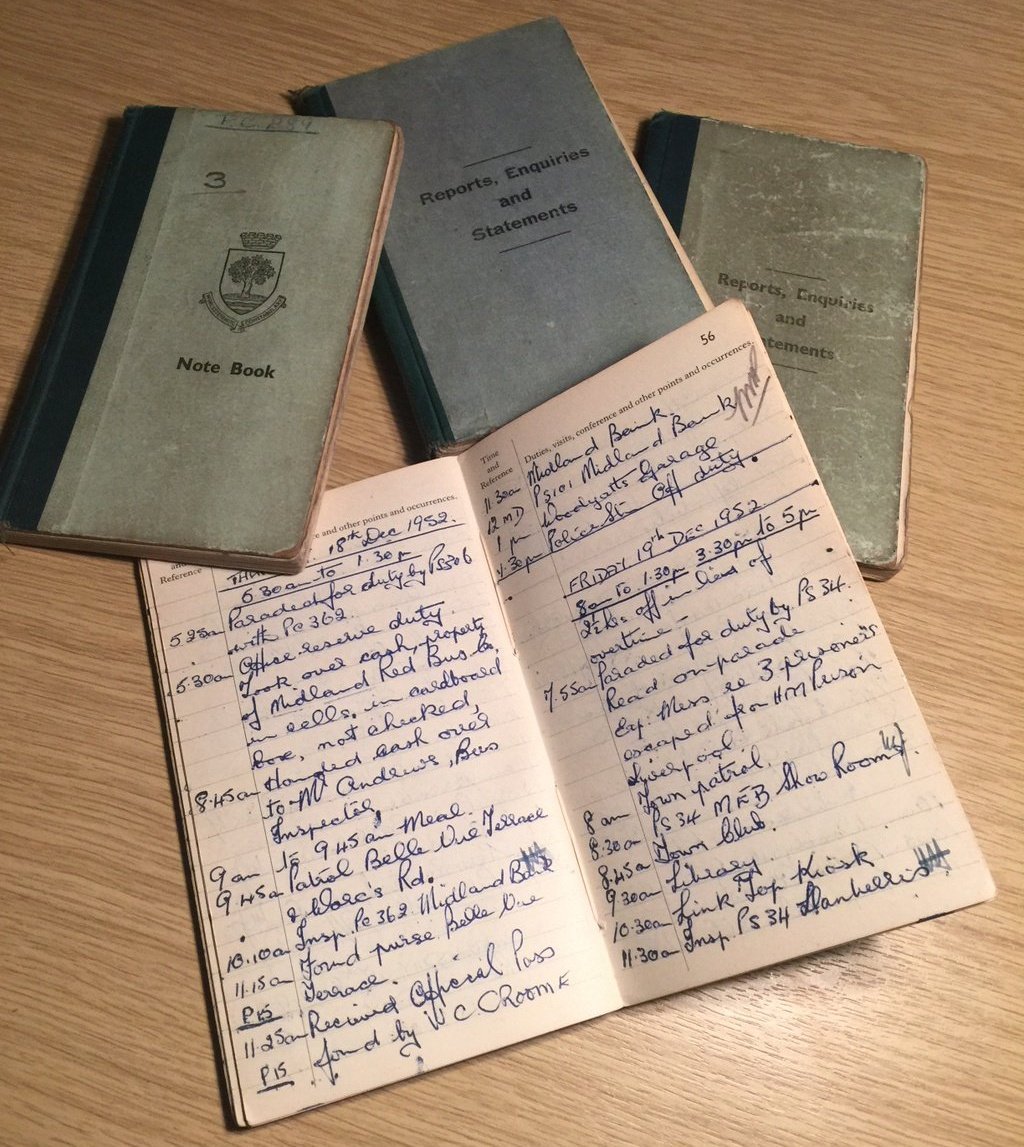
Paper remains the primary way police notes are captured, but its physical nature creates friction in the now digital-first legal system. Notes are captured in one moment but relied on much later. As notebooks move across time and systems, gaps emerge:
Clarity gap: Illegible handwriting and misinterpreted shorthand can derail a case during testimony.
Physical fragility: Paper is easily damaged, lost, or degraded over the months or years between the incident and the trial.
Retrieval challenge: Thousands of notebooks must be stored at the agency and manually searched through. Finding one specific interaction requires a page-flip search through physical archives.
Paper still works in the field, but modern evidentiary demands require a level of searchability and permanence that paper simply cannot provide
Why this was a design problem
The constraints of police note-taking could not be resolved through policy or process alone. They required deliberate design choices about how information is captured, structured, and preserved over time.
Design needed to account for:
Continuous chain of custody: Maintaining a clear line of integrity from the initial capture in the field through to courtroom disclosure.
Frictionless rigor: Supporting evidentiary standards without slowing the officer down when compared to paper.
Trust: Ensuring that digital records are legible, searchable, and tamper-proof to stand up to legal scrutiny at scale.
Operational resilience: Working within the fragmented, high-interruption realities of frontline work.
Mental model alignment: Bridging the gap between deeply ingrained paper habits and digital efficiency to ensure long-term adoption.
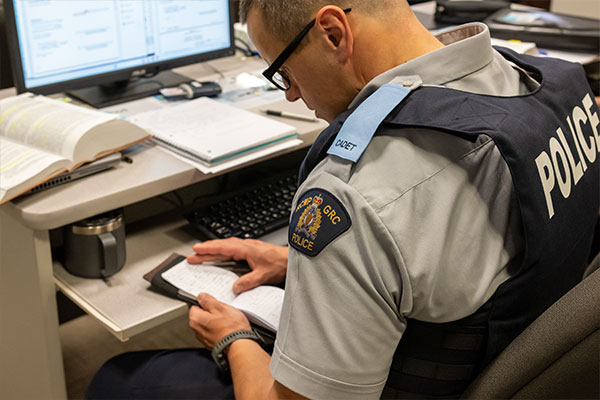
The Legacy Workflow: For decades, paper was the only "court-ready" system, creating massive data silos and searchability hurdles.
User problem
Frontline police officers are required to document every interaction they have during a shift, often while moving between calls, managing interruptions, and operating in unpredictable conditions. Despite the need for precision, the current paper-based workflow offers little support for the physical and cognitive realities of the job.
The Physical Constraint: Officers work fully geared. Body armor, radios, weapons, and other equipment already restrict movement. While a notebook is a standard part of the kit, relying on it as the primary entry point for every detail is cumbersome. Moving documentation to a digital device allows the physical notebook to become a secondary backup rather than a constant, prominent necessity.
The Cognitive Gap: In practice, many notes are written in patrol cars after an interaction has ended, sometimes at the end of long shifts. Relying on memory at the end of a long shift introduces risk of missing or inaccurate details.
The Retrieval Tax When a case goes to court months later, the lack of searchability becomes a time sink. Because paper notes are recorded chronologically rather than by case or person, officers and supervisors are forced into a manual, page-by-page search to find the note about a specific event.
Design framing
Constraints
High regulatory scrutiny: Every design choice must withstand legal cross-examination and strict compliance standards.
Zero data loss: There is no margin for data loss, sync errors, or system downtime.
Behavioral inertia: Overcoming decades of deeply ingrained paper-based habits and physical mental models.
Policy fragmentation: Navigating wide variations in documentation standards and legal requirements across different agencies.
Goals
Frictionless adoption: Replace paper as the primary record-keeping tool without increasing the officer’s cognitive load.
Seamless rigor: Support evidentiary rigor and data integrity without creating hurdles for the officer.
Operational resilience: Ensure 100% reliability, including full offline capability.
Standardized flexibility: Create a core framework that scales across agencies while respecting local policy variations.
Key design decisions
Architecting an "append-only" record
The challenge: In the paper world, notes must be chronological with no gaps to prevent tampering. In a digital world, officers need the flexibility to fix typos or pause a note to respond to a higher-priority call.
The solution: I designed a rolling finalization window that balances officer flexibility with evidentiary integrity.
The 24-hour grace period: Officers have a set window (typically 24 hours) to refine their notes, correct typos, and ensure accuracy. This accommodates the fragmented nature of the job where a note started at 2:00 PM might not be finished until the end of a shift.
The transition to the indelible record: Once the note is finalized by the office, or the time window expires, the record is locked down. Any further changes must be added as a supplement, preserving the original entry for the court.
Configurable compliance: To handle the variety of policies of different locales, the finalization timeframe is configurable by the agency to align with the specific requirements of their local prosecutor’s office.
2. Bridging the gap: structured data vs. narrative freedom
The challenge: To make notes searchable and light up future workflows, like instantly seeing if an officer has encountered a specific person before, the system needed structured data (names, IDs, plates). Engineering’s most efficient path was to put these forms at the start of the workflow, leveraging existing patterns from our Records product. However, this created a cognitive hurdle for the officer that didn't exist in the paper world.
The solution: I advocated for a narrative-first UI that prioritizes the officer’s story while intelligently capturing data.
Protecting the flow: I influenced the experience to stay focused on the narrative entry. Instead of forcing a multi-step form before they could start writing, I designed a system where adding people and vehicles felt like an optional enhancement to the story, not a prerequisite.
Balancing friction: By resisting the easiest engineering solution, I ensured the digital experience remained faster and more intuitive than paper. We captured the metadata needed for downstream searchability without sacrificing the speed of documentation.
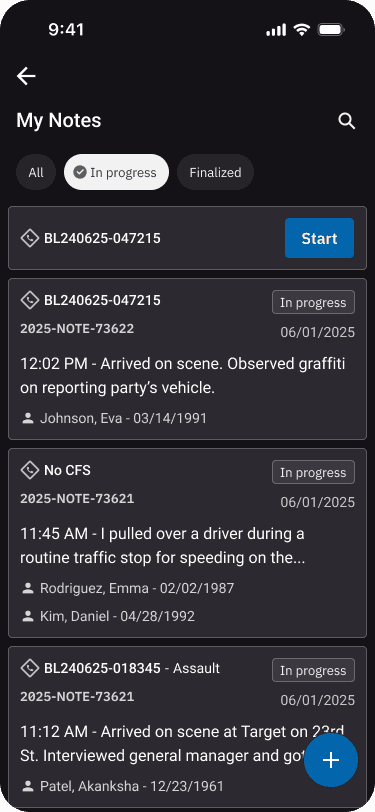
I prioritized "resume-ability" to account for constant interruptions in the field, making the most frequent actions the easiest to hit.
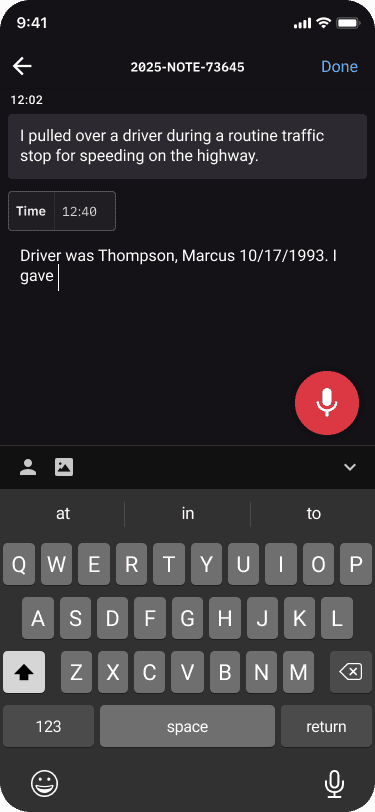
Dictation transforms the note-taking experience for officers on the move, reducing the "eyes-down" time and increasing situational awareness.
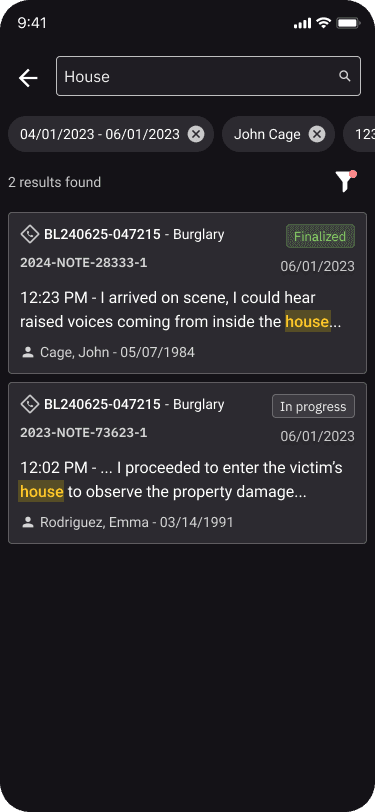
Transitioning from physical page-flipping to instant, filtered search allows supervisors and officers to find critical evidence in seconds rather than hours.
Note-taking often happens between calls, in vehicles, or immediately after an interaction. To reduce friction and improve safety, officers could narrate notes instead of typing. Dictation allowed officers to capture observations while driving or moving, aligning documentation with how and where the work actually occurs.
The challenge: Documentation often happens in high-stress, mobile environments where a keyboard can be a hindrance.
The solution: I optimized the interface for how and where the work actually occurs: in vehicles and between calls.
Voice-first workflow: To improve safety and reduce friction, the team integrated dictation, allowing officers to narrate observations while driving or moving. This aligned the tool with the physical reality of the job.
Rapid time-stamping: I explored the use of keyboard and voice-activated shortcuts to instantly insert the current time into a note. This helps officers create a high-accuracy outline of an event in real-time or build a framework to fill in later without the cognitive load of constant time-checking.
Impact & outcomes
Enabling global growth
The successful launch of this digital note-taking system was a critical milestone in Axon’s expansion. By aligning the product with Canadian evidentiary standards, we cleared the path for the Records team to enter a new market and convert early pilot agencies into long-term Records customers.
Building trust through design
My involvement in pre-contract agency visits used design as a strategic sales tool. Showing designs and real-world capabilities before agencies signed up helped reduce the perceived risk of moving away from paper, ultimately securing the early adopters needed for the product's successful rollout.
Design leadership & mentorship
A key success of this project was the development of the design team. I provided direct mentorship to a designer in Vietnam, coaching them on communication, stakeholder management, and design execution. By the time the project launched, they had grown into the work enough to take over as the primary designer for its next phase, ensuring a seamless transition and continued product growth.
Operational efficiency
Standardized clarity: Moving from physical notebooks to digital records eliminated the legibility gap. This ensured that every note was instantly readable and professional, removing the risk of misinterpretation caused by varied handwriting.
Judicial acceptance: Our rigorous, tamper-proof design architecture met the high bar for data integrity required by the Crown. This led to the successful acceptance of these digital records as defensible evidence in court.
Streamlined disclosure: We replaced manual, page-by-page reviews with a centralized search. This transformed a labor-intensive search process for supervisors and officers into a quick, streamlined workflow.